
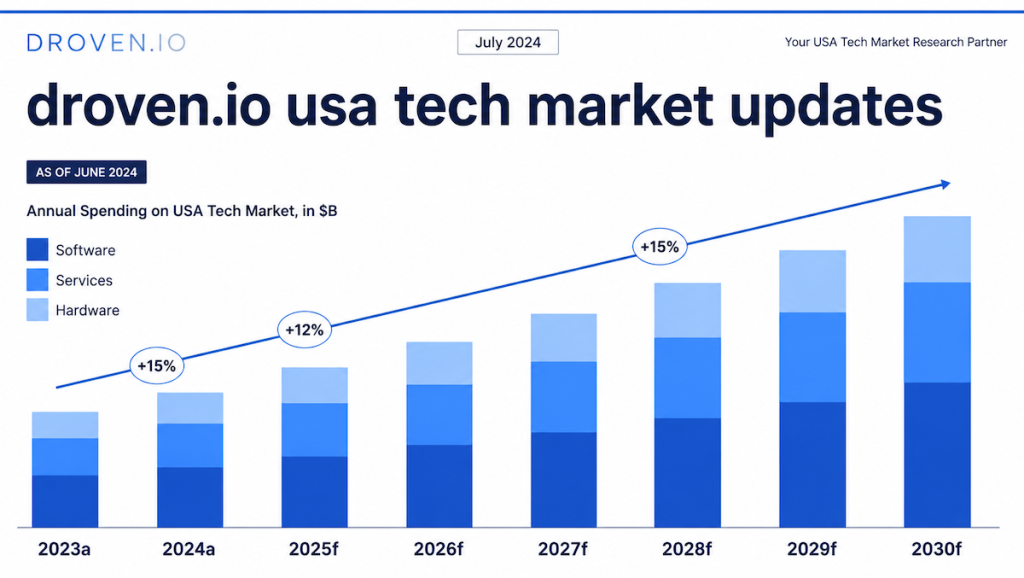
Droven.io USA tech market updates cover the forces reshaping American technology: artificial intelligence adoption, cloud infrastructure decisions, cybersecurity spending, IT services delivery and digital transformation. This guide covers all of them properly, rather than simply describing where the coverage lives.
Most articles about this topic explain that a platform publishes updates and stop there. We took the same approach with Model XUCVIHKDS, where the gap between what is written about a term and what can actually be verified is wider still. That is not much use if what you actually wanted was the updates.
So this one is organised around the shifts themselves — what is changing in each area, why it is changing, and what it means for a business, an investor or someone deciding what to learn next. It is written around structural forces rather than this week’s headlines, so it stays accurate.
What Droven.io Actually Is
Droven.io is described consistently across sources as an editorial knowledge platform publishing educational content on artificial intelligence, automation, machine learning, cloud computing and cybersecurity, with a focus on the United States technology market.
What it is not is equally clear, and one of the better write-ups puts it plainly: it is not a software company, a tool marketplace or a course provider. There is no login, no subscription and no product demo behind the articles.
The distinction that matters is between the research layer and the execution layer. Droven.io sits in the research layer. It will explain what workflow automation is and where it tends to fail; it will not build or run the automation for you.
That positioning is the reason people search for it. Most technology writing online comes from companies with something to sell, and the analysis bends accordingly. A platform with no product to push can describe a category without steering you toward a purchase, which is a genuinely different reading experience.
It also sets expectations correctly. The content is explanatory rather than investigative, aimed at general understanding rather than breaking news, and pitched at readers who are new to a topic rather than practitioners already deep in it.
What Droven.io USA Tech Market Updates Cover
The droven.io usa tech market updates group into five recurring themes, and they are worth naming before going into each one.
Artificial intelligence and machine learning. How American companies actually deploy generative AI, predictive analytics and increasingly agentic systems across finance, healthcare, logistics and marketing.
Cloud infrastructure. The move away from on-premise systems, the platform choices that follow, and the cost decisions that arrive eighteen months later.
Cybersecurity. Where budget is going, why it keeps rising, and how the threat surface changes as more of a business moves online.
IT services and delivery. How organisations resource technology work, and the shifting line between what gets built internally and what gets bought.
Startup formation and funding patterns. Where new companies are being built, and what investors are currently prepared to underwrite.
The coverage groups around real industry changes rather than isolated product announcements, which is the more useful framing for anyone trying to make a decision rather than follow a news cycle.
AI Adoption and the Droven.io Future of AI
The droven io future of ai theme runs through almost everything else, and the honest summary of where US adoption actually stands is more nuanced than either the enthusiasts or the sceptics suggest.
The pattern that has emerged is a split between experimentation and deployment. A very large share of organisations have trialled generative AI somewhere. A much smaller share have it running in production against a process that matters, with monitoring, ownership and a measurable result attached.
The gap between those two states is where most of the interesting work sits, and it is rarely a technology problem. It is data readiness, process definition and the question of who is accountable when the system is wrong.
Where adoption has stuck, it tends to share three characteristics. The task is high-volume and repetitive rather than rare and complex. A human reviews the output before it reaches a customer. And there is a clear fallback when the model fails, because it will.
Customer support, document processing, code assistance, fraud detection and content drafting all fit that shape. Strategic decision-making does not, which is why pilots in that direction quietly disappear.
On the droven.io ai startup side, the market has become notably more selective. The bar has moved from having an AI feature to solving a defined problem with a business model that survives inference costs. The questions investors now ask early are about proprietary data, retention and unit economics rather than model choice — because the model is increasingly a commodity and the data around it is not.
The practical read for anyone following this: watch what companies renew, not what they announce.
Cloud and Droven.io Enterprise Tech Innovation
Cloud coverage within droven.io enterprise tech innovation has shifted from a migration story to a management one, and that shift is the single most useful thing to understand about the category.
The first wave was straightforward: move workloads off owned hardware, gain flexibility, stop buying servers. Most American organisations of any size have now done that for most of what they run.
The second wave is about what happens afterwards, and it is less comfortable. Cloud spending has a habit of growing faster than the business it supports, because the same elasticity that lets you scale up quietly lets you leave things running. The discipline of tracking cost per workload, rather than one aggregate bill, is now a genuine competitive difference.
Two counter-movements are worth watching. Repatriation, where predictable high-volume workloads move back to owned infrastructure because the economics reverse at scale, and which is real but far narrower than headlines suggest. And deliberate multi-cloud, adopted less for resilience than for negotiating position.
AI has changed the calculation again. Training and inference demand a different infrastructure profile from ordinary applications, and organisations that optimised their cloud estate for web workloads are discovering their assumptions no longer hold.
Cybersecurity in Droven.io USA Tech Market Updates
Security appears throughout the droven.io usa tech market updates for a simple reason: it is the one budget line that rarely gets cut, and understanding why explains a lot about how technology decisions actually get made.
The attack surface expands with every system a business connects. More cloud services, more integrations, more remote access, more third-party tools — each one useful, each one another way in. Security spending grows because the surface it defends grows, not because the tools keep getting more expensive.
The structural shift worth understanding is the move from perimeter thinking to identity thinking. The old model assumed a trusted inside and a hostile outside. That distinction stopped being meaningful once staff worked from anywhere and half the stack lived on someone else’s servers. What replaced it treats every request as unverified regardless of origin, which is a considerable change in how systems get designed.
The other change is supply chain. Compromising one widely-used component reaches everyone who installed it, which is why dependency auditing has moved from a specialist concern to something ordinary development teams are expected to do.
Droven.io IT Services in USA
Coverage of droven.io it services in usa deals with how organisations actually resource technology work, and the line has moved substantially in the past few years.
The old split was simple: build what differentiates you, buy what does not. That still holds in principle, but the definition of differentiating has narrowed. Very few organisations now build their own authentication, payments, messaging or analytics, because the bought versions are better than anything they would produce and the maintenance never ends.
What has grown in its place is integration work. When a business runs thirty services rather than three systems, the value moves to making them work together, and that is where a great deal of American IT services demand now sits.
Managed services have expanded for a related reason. Specialist skills — security operations, cloud cost engineering, data platform work — are expensive to hire and difficult to retain at the scale most organisations need them. Renting a fraction of a team is often the only sensible option.
The question worth asking of any provider is what happens at the end. Services arrangements that leave a business unable to operate its own systems are a liability that only becomes visible when the relationship ends.
Drovenio AI in Digital Transformation
The drovenio ai in digital transformation theme is where the previous four converge, and it is also where most of the failure happens.
Digital transformation has a poor reputation because a great many programmes have delivered new systems without changing any outcome. The pattern is consistent: an organisation replaces the software supporting a process without examining the process, and ends up doing the same thing slightly faster at considerable expense.
AI has sharpened this, because automating a broken process makes it broken at higher speed and with less visibility. The organisations getting value are the ones treating automation as an opportunity to ask whether a step needs to exist at all.
The pattern that works is unglamorous. Start with one process that is genuinely painful and genuinely measurable. Establish what good looks like before changing anything. Change it. Measure again. Then move to the next one.
That approach is slower than a transformation programme and considerably more likely to produce something. It is also the version rarely presented at conferences, because incremental improvement makes a poor keynote.
Who Droven.io USA Tech Market Updates Are For
Being specific here saves people time, so it is worth stating who gets value and who does not.
Business owners deciding where technology spending should go, who need to understand a category before meeting a vendor who will explain it in their own favour.
Career changers and students working out which areas are growing and what to learn, where a plain-language overview is worth more than a technical deep dive.
Generalists in technical organisations — marketers, operations leads, product managers — who need enough grounding to hold a sensible conversation with engineering.
Investors doing early orientation, before the real diligence starts.
It is less useful for practitioners already working in a field, who will find the depth insufficient, and for anyone needing current figures, since explanatory content is not a data source.
What Droven.io USA Tech Market Updates Won’t Give You
Three things, and knowing them up front prevents disappointment.
Breaking news. The content is explanatory rather than real-time. For same-day coverage, established technology outlets do that job and this does not attempt to.
Primary data. Market sizing, funding totals and adoption percentages need to come from analyst firms, regulatory filings or the organisations publishing the research. Educational content summarises; it does not measure.
Implementation detail. Understanding what a category does is a long way from knowing how to deploy it. Vendor documentation and practitioner communities cover that ground.
Used for orientation rather than as a single source, that combination of limits is reasonable rather than disqualifying.
Frequently Asked Questions
What are droven.io usa tech market updates?
Educational coverage of the United States technology market across artificial intelligence, cloud computing, cybersecurity, IT services and digital transformation, explaining what is changing and why rather than reporting daily news.
What is droven.io?
An editorial content platform publishing explanatory technology articles. It is not a software company, a marketplace or a course provider, and there is no login, subscription or product behind the articles.
Is droven.io free to read?
Yes. The content is open with no subscription or paywall, which is consistent with its positioning as an editorial resource rather than a commercial platform.
What does droven.io cover on AI?
Machine learning, generative AI, predictive analytics and intelligent automation, with an emphasis on how American businesses actually deploy them rather than on model capability alone.
Are droven.io usa tech market updates reliable?
Sound for general orientation and written in accessible language. Verify anything you intend to act on commercially against analyst research or primary sources, as with any explanatory content.
What are droven.io it services in usa about?
How organisations resource technology work: the build-versus-buy line, the growth of integration work, and the expansion of managed services for specialist skills that are hard to hire and retain.
Does droven.io cover startups?
Yes. Startup formation and funding patterns are a recurring theme, particularly around what distinguishes a genuine AI company from one using the term as positioning.
Where should I go for deeper technical detail?
Vendor documentation for implementation, analyst firms for market data, and practitioner communities for what actually breaks in production. Explanatory content is a starting point rather than a destination.
Reading Droven.io USA Tech Market Updates Properly
The value in droven.io usa tech market updates is orientation. They tell you which categories matter, what the vocabulary means and roughly where the market is heading, which is exactly what you need before a vendor conversation or a hiring decision.
The forces above are the ones worth tracking: whether AI pilots become production systems, whether cloud spending is managed or merely incurred, whether security is designed in or bolted on, and whether transformation programmes change processes or only the software running them.
Follow those and you will understand the American technology market better than most of the coverage explaining it.