

Most mobile strategy games ask you to wait. You tap a building, a timer starts, and the actual decision-making happens somewhere between a notification and an energy bar. For anyone who grew up on real-time strategy, that trade feels backwards: all of the resource management, none of the panic when your front line collapses.
The alternative is a game where every unit is yours to move, right now, and where losing your gold flow costs you the match in about ninety seconds.
Stick War: Legacy is that game. It came out of one of the most played web strategy titles ever made, and the mobile version, published under the name Max Games Studios, kept the thing that made the original work: total control over every stickman on the field. You can set formations and let the army behave like an army, or drop into a single archer and aim him yourself.
Gold, miners, statues
The economy is the whole game. Miners pull gold from a deposit behind your lines, gold buys units, and units either push toward the enemy statue or die trying. Destroy that statue and the territory is yours.
What makes it tense is that miners are also spendable. Every one you build is gold you’re not putting into a Spearton right now, and the correct number changes depending on whether the enemy is rushing you or turtling. Get it wrong early and you spend the rest of the match a step behind.
Territory capture strings these battles into a campaign across Inamorta, with each faction fighting differently enough that a single strategy will not carry you through.
Sword, spear, archer, mage
Four disciplines, plus Giants once you can afford them. Swordwrath are cheap bodies you throw forward. Speartons hold a line and stop cavalry-style pushes cold. Archers do damage from behind everyone else, provided nothing reaches them. Mages handle clumps.
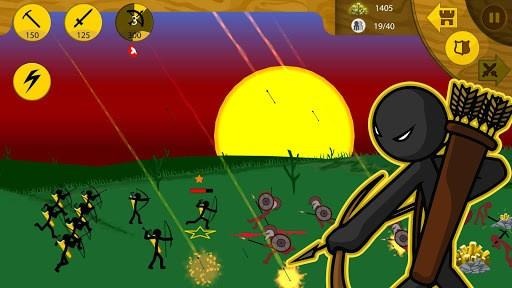
The counters are readable, which is the point. You are not memorizing hidden stats, you are watching a fight go badly and deciding whether to pull your archers back or commit a Giant and hope it lands.
Manual control is where the skill ceiling sits. Grabbing one archer out of a group and repositioning him during a melee is the difference between trading evenly and winning a fight you should have lost.
Stick War: Legacy on Windows
The pull toward desktop here is precise clicking. Selecting one archer out of a scrum of twenty stickmen is fiddly on a phone screen and trivial with a mouse, and once your selection starts landing on the wrong stickman during a crowded push, it’s time to bind selection and formation commands to keys instead. Sort that out before you commit to a long campaign run across Inamorta, which is exactly what a guide on how to play Stick War Legacy on PC walks through. BlueStacks handles the keyboard mapping most people want. LDPlayer is the other common choice if you prefer its control editor.
Beyond that, there is not much to configure. This is a lightweight game that benefits from a bigger view of the battlefield more than it benefits from hardware.
Skins as loadouts
The skin system is easier to dismiss than it should be, because it is not cosmetic. Leaf skins are light and cheap, so units build faster and move faster, which suits an early rush or a game where you are trying to out-tempo an opponent rather than out-muscle them.
Ice skins carry magic that freezes and slows whatever they hit. Slowing an incoming wave buys your archers extra volleys, and that is often the entire margin.
Because each skin set comes with its own weapons, armor and perks, choosing them is closer to picking a loadout than picking a color. Two players with identical unit compositions can play completely different games.
Where the game turns on you
The difficulty curve is honest. Early territories teach you the units, then the game starts sending compositions built specifically to punish whatever you have been leaning on. If you have been winning with mass Swordwrath, you will meet something that shreds mass Swordwrath.
This is why it holds up for a strategy-minded audience rather than a casual one. There is no timer to wait out and no way to buy your way past a bad decision at the mining deposit.
Which brings it back to that first choice every match: how many miners before your first fighting unit. On a desktop, with keys bound and the whole field visible, you get to answer that question faster and watch it play out in real time.